The Andrew Murray Prayer Life: A Room, a Door, an Hour
⏱ 7 min read
If you have gone looking for the Andrew Murray prayer life — what the man actually did in the morning, not what he believed about prayer — you will have noticed how rarely anyone answers the question. Murray is remembered for what he taught. He is less often read for what he told people to actually do with their mornings, and that is a pity, because the instructions are unusually specific.
Murray was a Dutch Reformed pastor in the Cape, based for the long back half of his life in Wellington, South Africa. He preached, founded schools, and wrote steadily for decades — short books meant to be used rather than admired. Read enough of them and a pattern surfaces. Before Murray says anything about faith, or surrender, or the indwelling life, he tends first to say something about a room, a door, a clock, and a posture. The theology comes second. The furniture comes first.
What is a prayer closet? Murray’s inner chamber, plainly meant
Murray’s phrase for the place of prayer is the inner chamber — the closet of Matthew’s Gospel, the shut door, the Father who sees in secret. He means it flatly. Not the heart as a metaphorical chamber. A place, entered at a time, with the door closed.
Readers reasonably ask what such a room is supposed to contain. In Murray the answer is almost disappointingly thin: a door that shuts, an hour decided in advance, and nobody watching. The word the King James translators rendered closet in that passage means a storeroom — the small inner room of an ordinary house, chosen because it was private rather than because it was holy. Murray keeps that ordinariness; a bedroom corner before the house wakes will do as well as a study, and he never once suggests the room itself is what works.
How did Andrew Murray pray? The instruction is physical before it is spiritual
His instructions read less like mysticism than like directions to a house. “Enter your closet at the appointed time, however dull you feel, and place yourself before your Lord.” — Andrew Murray, The Ministry of Intercession. Note the ordering. An appointed time means a decision made in advance. A closet means somewhere. And the phrase that does the real work: however dull you feel. Feeling is not the entry condition. Arrival is.
The same practicality shows up in his instruction to stop before starting. “Before you pray, bow quietly before God, just to remember and realize who He is, how near He is, how certainly He can and will help.” — Andrew Murray, Waiting on God. That is a pause with content in it, placed deliberately between sitting down and speaking — not garnish, but the thing that makes the words afterwards mean anything.
He repeats himself about it, and knows he is repeating himself. “You will find in it the reason why we have said several times that when you read or pray you must at every opportunity keep quiet for a little while and set yourself in entire silence before God.” — Andrew Murray, The New Life. A little while. He rarely quantifies it, but he assumes such a gap will not arrive by accident.
How much time the Andrew Murray prayer life asks for
If Murray asks for one thing over and over, it is unhurried time — not intensity, not eloquence, not feeling. Time.
“Take quiet time, and be still before God, that He may take this matter in hand.” — Andrew Murray, The Ministry of Intercession. And elsewhere, in a sentence he puts into the reader’s own mouth: “I will take time, and just be still, and rest in the light of God.” — Andrew Murray, Waiting on God. The verb is take. Time of that kind is not found lying about; it is removed from somewhere else.
He also names the competition. “Withdraw yourself from all needless distraction, close your ears to the voices of the world, and be as a docile learner, ever listening for the heavenly wisdom the Master has to teach.” — Andrew Murray, Abide in Christ. He wrote that in a century of letters and newspapers; the problem has changed in scale rather than in kind.
What he promises in return is modest and slow. “Be quiet before God, and give Him time and opportunity; in due season you will learn to pray.” — Andrew Murray, The Ministry of Intercession. In due season. Not tonight.
What Murray did not mean, and where the tradition argues with itself
Two clarifications are owed, because Murray is easy to misuse in both directions.
The first: nothing in Murray amounts to a technique of the body. He prescribes conditions — a place, a shut door, a set hour, a bowed posture, a pause before speech, time that has not been hurried. He does not teach breathing patterns or anything a modern wellness vocabulary would recognise as a method, and any writer who claims the old devotional authors did is inventing a lineage. The honest claim is narrower and more useful: Murray never treated the body and its circumstances as irrelevant to prayer. He assumed a person prays somewhere, at some hour, in some condition, and that these facts are not neutral.
The second: this whole family of language has been contested inside the tradition, and not by outsiders. John Wesley, a century before Murray, fought a bruising dispute with the Moravian teachers around the Fetter Lane society over precisely this vocabulary — the doctrine of stillness, which in its strong form counselled believers to cease from the ordinances, from communion and searching the Scriptures, and simply be still until faith was given. Wesley judged it a counsel of paralysis, and broke with it. His warning has not expired. Stillness taught carelessly does turn into waiting for a feeling and calling the wait obedience.
Murray’s higher-life associations have drawn the same criticism. But he sits closer to Wesley than the vocabulary suggests: his stillness is always attached to an action already begun. “Begin to pray in a quiet sense of your ignorance and weakness, but in a joyful assurance that He will work in you what you need.” — Andrew Murray, The Ministry of Intercession. Begin. And when he does write about waiting for God to act, he is careful to say who is doing the acting: “Just bow in stillness and wait before God, until, as God, He overshadow you with His presence, lead you out of that region of argument as to human possibilities, where conviction of sin can never be deep, and full deliverance can never come.” — Andrew Murray, The Ministry of Intercession. The silence is not the point. It is the posture in which something else is expected. Whether that distinction always holds under pressure is a fair question, and readers may hold Murray to it.
What to do when prayer will not start
Murray is at his best on the ordinary failure, which is the day the prayer will not start.
He describes it without flattering the reader. “You feel this yourself when you want to pray, and cannot, because of the things that stand between you and God.” — Andrew Murray, To Be Near Unto God. Not the things that stand between the reader and their goals. Between the reader and God — which is a harder sentence, and an older one.
His counsel in that state is not to summon feeling but to lower the requirement. “Set your soul still before God in holy silence, for Him to give you wisdom; rest, in emptiness and poverty of spirit, in the faith that He will work in His own way.” — Andrew Murray, Holy in Christ. Emptiness is permitted. It is assumed.
And when the answer does not come at all: “Hence when an answer to prayer tarries, let not the soul grow faint.” — Andrew Murray, To Be Near Unto God. He does not say the delay will be short, or promise the thing will be granted. He asks only that the soul not collapse in the interval — a smaller and more honest request than most devotional writing makes.
The gentlest sentence he wrote on the subject is also the plainest. “Be quiet, and trusting, and resting, and the everlasting God will shine into your heart, and will reveal Himself.” — Andrew Murray, The Master’s Indwelling.
Why he starts with bodies before souls
One line, from a book about service rather than prayer, belongs beside all this: “If you think you are not able to labour for souls, begin with the bodies.” — Andrew Murray, Working for God.
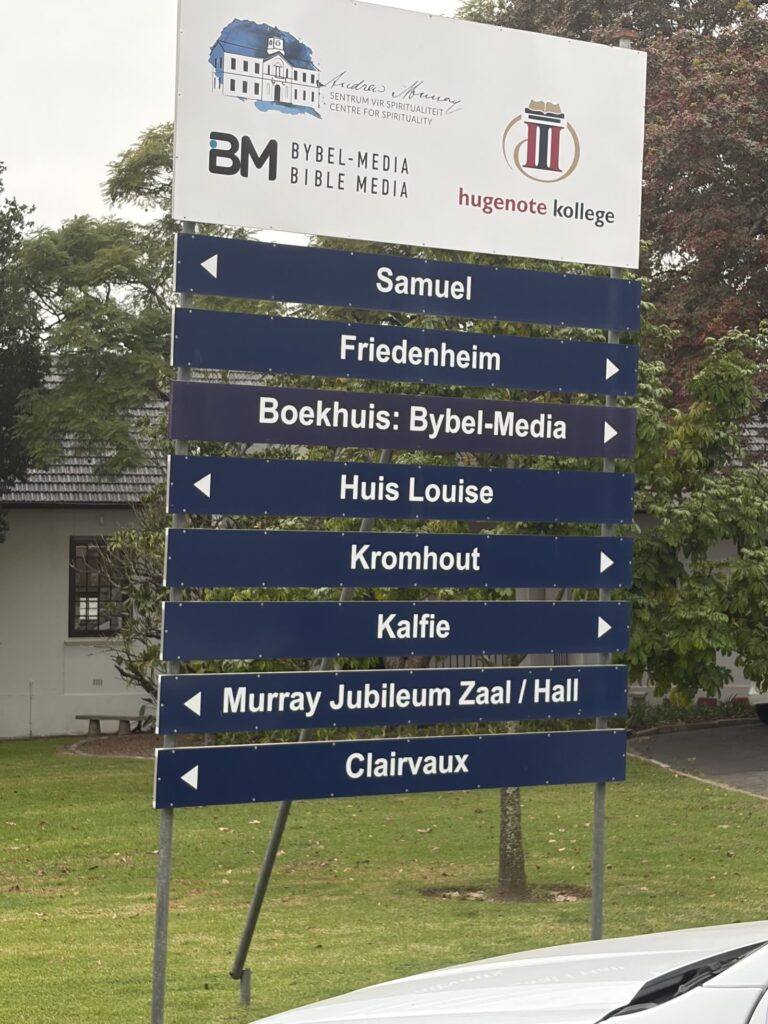
The context is practical charity, not devotion. But it is the same instinct that puts a door and a clock at the front of his prayer instructions. Murray does not float. He starts with what can be handled — a room, an hour, a meal, a body — and expects the invisible work to meet him there. Readers wanting more of that side of him will find the wider survey in the complete Andrew Murray reader’s guide, and a note on the Wellington ground he walked in the piece on the Andrew Murray Centre for Spirituality.
A small closing note
This is the reason a Stilling Waves journal day opens with a brief pause before the reading rather than a paragraph of instruction. It is not a technique, and not borrowed from anywhere fashionable. It is Murray’s ordering, kept: bow quietly first, then read, then speak. A page cannot make anyone still. It can hold the door open for a moment before the words start, which is roughly what the old books were asking for.
This article belongs to a series on what the older devotional writers actually taught about the body in prayer. The overview is here: Does the Body Matter in Prayer? What the Old Writers Said.
More on this author: Andrew Murray: The Complete Reader’s Guide and inside the Andrew Murray Centre.